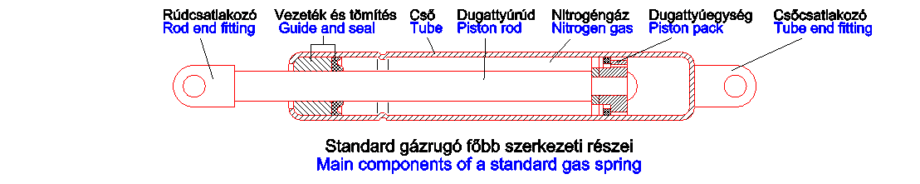
A standard gas spring is a self-contained unit consisting of a pressure tube filled with high-pressure gas and a piston rod (Figure 2). A piston with an orifice is located at the internal end of the rod, ensuring that the pressure remains equal on both sides of the piston. Since the surface area on the rod side is smaller by the cross-section of the rod itself, the gas pressure exerts a force that pushes the rod outwards.

The theoretical spring force is calculated as F = Ar p can be calculated using the following formula, where:
Gas springs manufactured byr the cross-section of the rod,
p is the filling gas pressure in the pressure tube

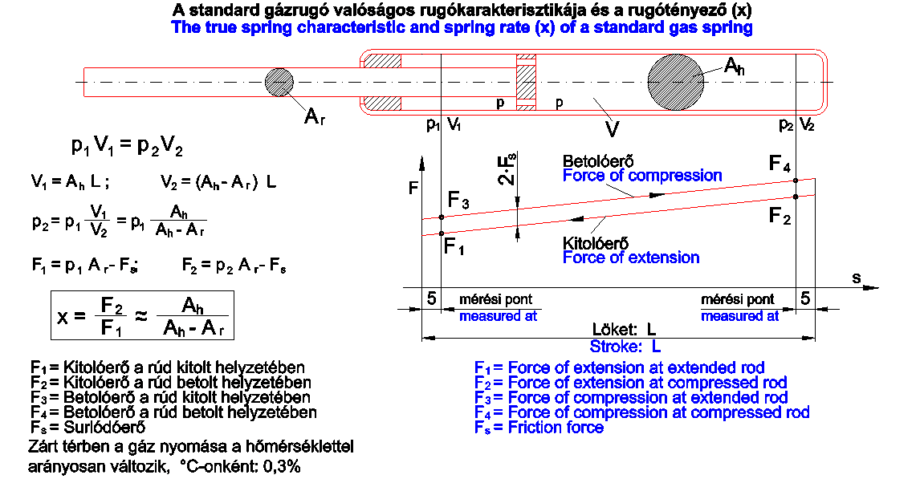
Figure 3 – Actual spring characteristic and spring rate (x) of a standard gas spring
F1 = Extension force with the rod in the extended position
F2 = Extension force with the rod in the retracted position
F3 = Retraction force with the rod in the extended position
F4 = Retraction force with the rod in the retracted position
Fs = Friction force
p1 V1 = p2 V2
V1 = Ah L V2 = (Ah – Ar) L
| p2 = p1 | V1 | = p1 | Gas springs manufactured byh |
| V2 | Gas springs manufactured byh – Ar |
F1 = p1 Gas springs manufactured byr – FsF2 = p2 Gas springs manufactured byr – Fs
| X = | F2 | ˜ | Gas springs manufactured byh |
| F1 | Gas springs manufactured byh – Ar |
Frictional resistance (friction force) increases the theoretical spring force during retraction and decreases it during extension.
In a closed volume, the gas pressure changes proportionally with the temperature, oby 0.3% per degree Celsius (°C)
MS08-1-1F6D-200-100-300

| Típus | Rod, d [mm] | Tube., D [mm] | K | Max. stroke, S [mm] | Extension force, F [N]1 [N]** | Max. L x F1*** | Spring- rate X | |
| MS06 | 6 | 15 | 35 | 400 | 30-400 | 60 000 | 1,3 | |
| MS08 | 8 | 18 | 54 | 400 | 100-800 | 150 000 | 1,35 | |
| MS08/23 | 8 | 23 | 57 | 400 | 100-800 | 150 000 | 1,19 | |
| MS10 | 10 | 23 | 57 | 500 | 100-1200 | 300 000 | 1,4 | |
| MS10/28 | 10 | 28 | 60 | 500 | 100-1200 | 300 000 | 1,21 | |
| MS14 | 14 | 28 | 60 | 1000 | 200-2500 | 800 000 | 1,5 |
* in 5 mm increments
** +20 Co– measured at
*** to avoid buckling of the piston rod
Available damping types: 1, 2, 3, 4.